Why Underwater ROV Inspection Is Essential for Your Vessel
What is an ROV and how does it work
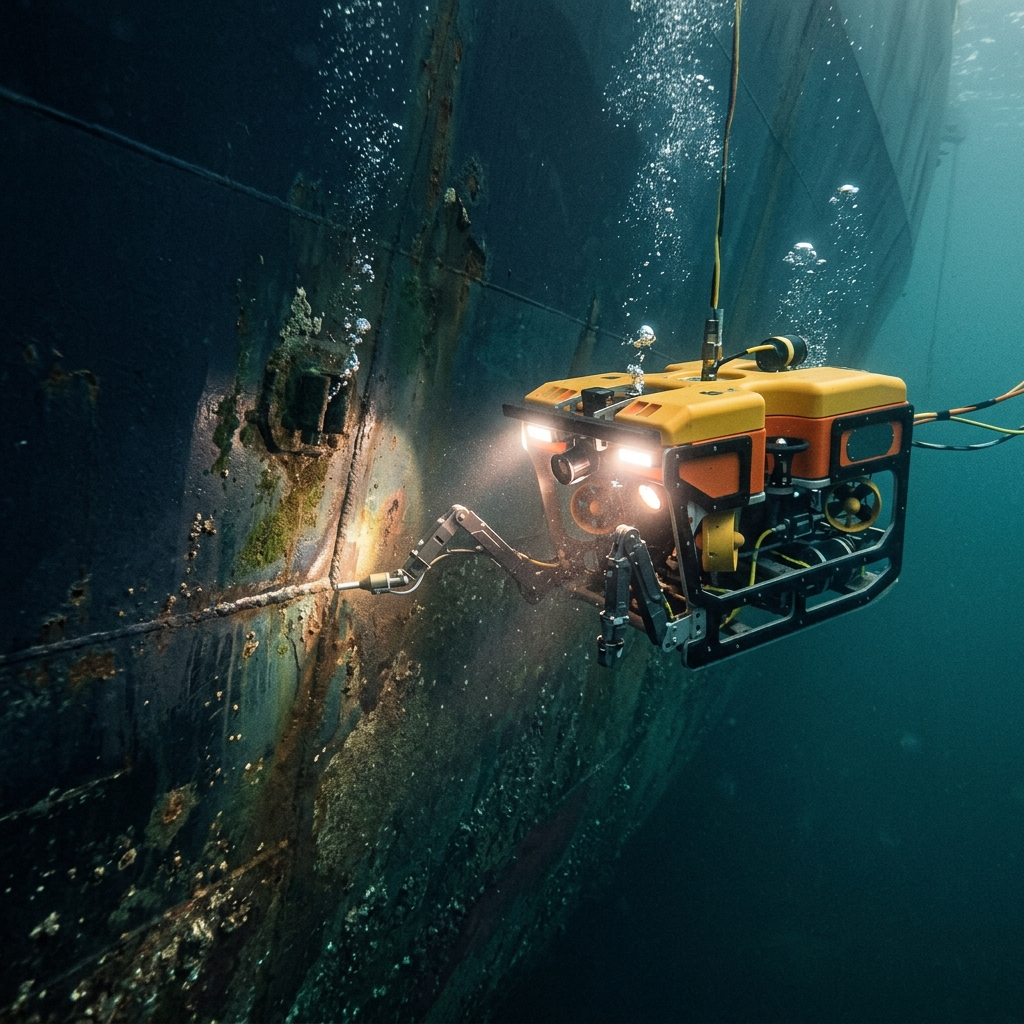
ROV (Remotely Operated Vehicle) is a remotely operated underwater vehicle equipped with high-definition cameras, powerful lighting, and in some models, measurement and cleaning tools. In maritime inspection, the ROV is submerged alongside the vessel and controlled by surface operators, transmitting real-time images of the entire submerged hull structure.
Unlike traditional diver inspections, ROV does not expose human lives to risks, operates in adverse conditions (strong currents, reduced visibility, deep waters), and can perform inspections while the ship is in operation — without the need to stop, anchor, or enter dry dock.
Why ROV inspection is indispensable
1. Elimination of dry docking for intermediate inspections
A dry docking costs between US$ 300,000 and US$ 1,000,000, depending on vessel size, and takes 7 to 21 days. During this period, the ship is out of operation, generating revenue loss. ROV inspection allows intermediate surveys (such as UWILD — Underwater Inspection in Lieu of Drydocking) accepted by major classification societies: DNV, Lloyd's Register, Bureau Veritas, and ABS.
2. Early detection of structural problems
The ROV precisely identifies: corrosion, cracks, deformations, weld damage, loss of cathodic protection anodes, anti-fouling paint deterioration, and biofouling accumulation. Early detection enables preventive interventions — much cheaper than emergency dry dock repairs.
3. Operational safety
Diver inspections involve significant risks: decompression sickness, drowning, marine currents, and exposure to contaminants. ROV completely eliminates these risks. The operator works safely on the surface with full equipment control.
4. Complete high-definition documentation
Every ROV inspection generates an archive of HD video and photographs of each inspected area, with coordinate and depth marking. This material is compiled into detailed technical reports serving as evidence for classification societies, insurers, and compliance audits.
5. Operation during loading/unloading
One of ROV's greatest advantages is the ability to inspect the hull while the ship is berthed or anchored, during loading and unloading operations. This eliminates the need for special mobilization and optimizes vessel time in port.
When to perform ROV inspection
- Intermediate surveys (UWILD): every 2.5 years (between 5-year dry dockings)
- Pre-purchase vessel assessment: hull condition evaluation before closing a deal
- Post-incident: groundings, collisions, or contact with submerged objects
- Repair verification: confirmation that dry dock repairs are intact
- Biofouling assessment: before hull cleaning to scope the service
- Propeller and rudder inspection: wear and cavitation evaluation
Arenna and ROV inspection
Arenna Logistics offers underwater ROV inspection services in all ports across Brazil. Our team operates with state-of-the-art equipment and generates complete reports with visual evidence, accepted by all major classification societies.
Request an ROV inspection for your vessel — without stopping operations.
Other Articles
Brazilian Customs Finds 43 kg of Cocaine Hidden in Container Structure at the Port of Santos
Brazil's Federal Revenue Service (Receita Federal) seized approximately 43 kilograms of cocaine concealed within the structure of a container at the Port of Santos, on the coast of São Paulo. The case...
Brazilian Customs Seizes 448 kg of Cocaine in Two Operations at the Port of Santos
Brazilian Customs Seizes 448 kg of Cocaine in Two Operations at the Port of SantosBrazil's Federal Revenue Service (Receita Federal) seized 448 kilograms of cocaine during two separate enforcement ope...