
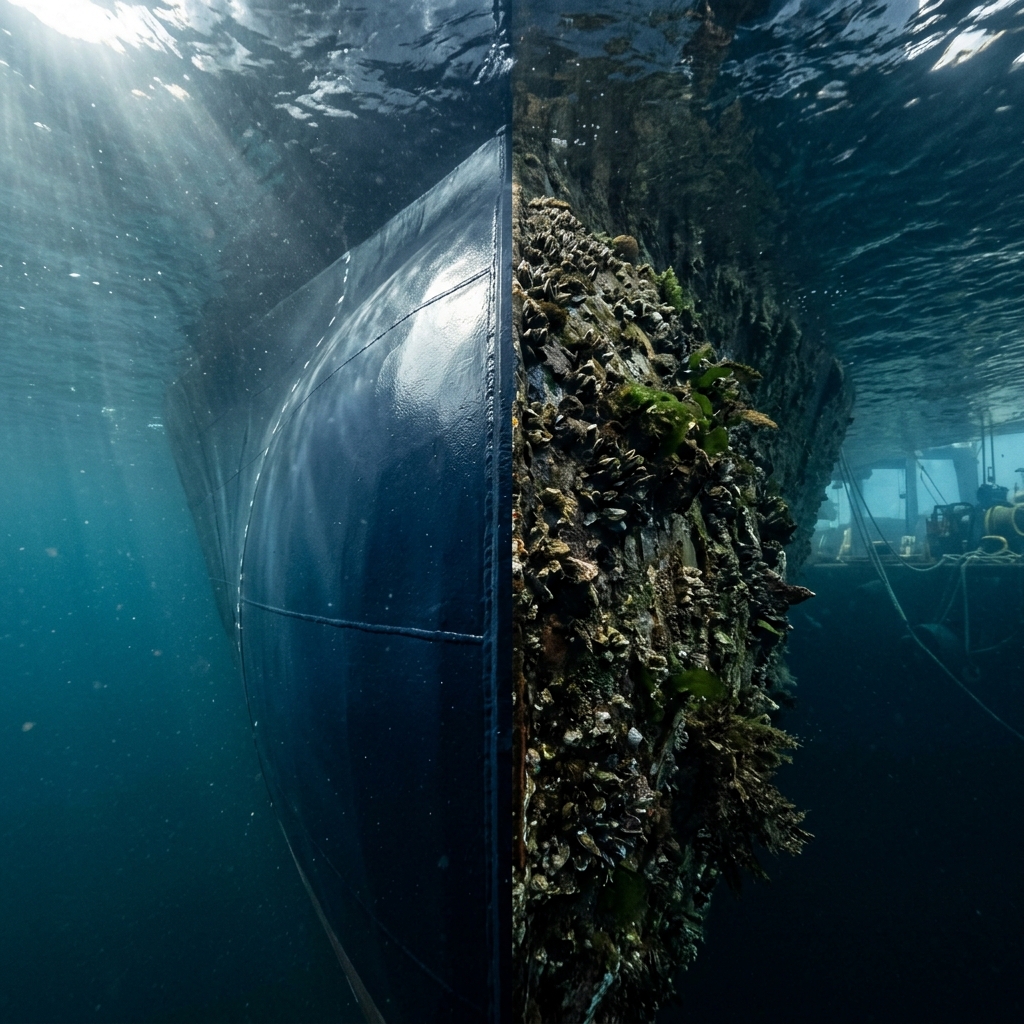
Dirty Hull: The Silent Enemy of Naval Efficiency
What is biofouling and why does it matter
Biofouling — the accumulation of marine organisms such as barnacles, algae, and mussels on vessel hulls — is one of the most underestimated problems in the maritime industry. What appears to be just a layer of dirt on the hull surface is actually a factor that directly impacts performance, operating costs, and environmental compliance of any vessel.
When a ship operates with a dirty hull, hydrodynamic resistance increases significantly. Studies by the IMO (International Maritime Organization) estimate that a biofouling layer of just 0.5mm can increase drag by up to 25%. In more severe cases with heavy encrustation, the increase in fuel consumption can reach 40% — representing millions of dollars in additional costs per year for a medium-sized fleet.
The concrete losses
1. Increased fuel consumption
Fuel represents between 50% and 60% of a ship's operating costs. A hull with moderate biofouling can raise consumption by 15% to 25%. For a vessel spending US$ 30,000/day on fuel, this means an additional loss of US$ 4,500 to US$ 7,500 per day — or up to US$ 2.7 million per year.
2. Speed reduction
With a dirty hull, the ship loses speed even while maintaining the same engine power. This means route delays, missed berthing windows, and contractual penalties with shipowners and port operators.
3. Greenhouse gas emissions
Increased fuel consumption proportionally raises CO₂, SOx, and NOx emissions. With increasingly stringent IMO regulations (including IMO 2030 and the decarbonization strategy), inefficient vessels may face carbon surcharges and operating restrictions in environmentally demanding ports.
4. Fines and environmental restrictions
Brazil's NORMAM-401 from the Navy, with penalties under Law 9.605/98 starting June 2026, establishes strict guidelines on biofouling management. Ships arriving at Brazilian ports with contaminated hulls may be prevented from operating and receive significant fines. Additionally, biofouling is a vector for invasive species — a growing concern for environmental agencies.
5. Accelerated hull wear
Encrustation not only increases drag — it also corrodes anti-fouling paint and eventually the hull steel itself. Maintaining a neglected hull is exponentially more expensive: what could be resolved with preventive cleaning can turn into the need for dry docking and complete repainting.
The solution: preventive cleaning and regular monitoring
Regular hull cleaning, performed by specialized teams like those at Arenna Logistics, is the most effective and economical method of combating biofouling. Our hull cleaning service uses techniques that remove encrustation safely and in an environmentally responsible manner, with photographic and video reports documenting the entire process.
Combined with underwater ROV inspections, which allow assessment of hull condition without dry docking, preventive cleaning becomes a strategic fleet management tool.
Conclusion
Ignoring hull condition is not saving money — it's multiplying losses. Every day of navigation with biofouling, the shipowner is literally burning money on wasted fuel, risking regulatory fines, and accelerating vessel wear.
Arenna Logistics offers hull cleaning services in all ports across Brazil, with 24/7 service and compliance with all applicable standards (NORMAM-401, IMO Guidelines, MARPOL).
Contact us and request a quote for your vessel's hull cleaning.
Other Articles
Brazilian Customs Finds 43 kg of Cocaine Hidden in Container Structure at the Port of Santos
Brazil's Federal Revenue Service (Receita Federal) seized approximately 43 kilograms of cocaine concealed within the structure of a container at the Port of Santos, on the coast of São Paulo. The case...
Brazilian Customs Seizes 448 kg of Cocaine in Two Operations at the Port of Santos
Brazilian Customs Seizes 448 kg of Cocaine in Two Operations at the Port of SantosBrazil's Federal Revenue Service (Receita Federal) seized 448 kilograms of cocaine during two separate enforcement ope...